The mid-term rental market has grown rapidly over the past several years.
Travel nurses, healthcare contractors, corporate relocations, and project-based professionals increasingly seek furnished housing for stays lasting 8–13 weeks or longer.
For landlords, the opportunity is clear.
The question is:
Where should you list your property?
Different platforms serve different models. Understanding the differences can help you align your property with the right audience.
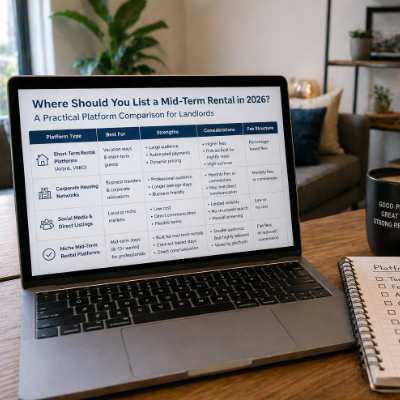
1. Short-Term Rental Platforms (Airbnb, VRBO)
Originally built for nightly vacation stays, short-term marketplaces now host longer bookings as well.
Strengths:
-
Large built-in audience
-
Automated payment systems
-
Dynamic pricing tools
Considerations:
-
Percentage-based service fees
-
Policies designed primarily for short-term stays
-
High turnover expectations
-
Competition from vacation listings
These platforms can work for mid-term rentals, but they are structured around nightly optimization rather than contract-based housing.
2. Corporate Housing Networks
Corporate housing platforms focus on furnished accommodations for professionals.
Strengths:
-
Business-focused audience
-
Longer average stays
-
Professional tenant base
Considerations:
-
Monthly listing fees or commission structures
-
Some operate as intermediaries
-
May limit direct communication
These platforms align more closely with mid-term rental goals but often involve higher cost structures.
3. Social Media & Direct Listings
Many landlords use:
-
Facebook groups
-
Local classifieds
-
Direct website marketing
Strengths:
-
Low cost
-
Direct communication
-
Flexible terms
Considerations:
-
Limited visibility beyond local reach
-
No structured search system
-
Manual screening required
This approach can work in strong demand areas but may lack consistency.
4. Niche Mid-Term Rental Platforms
A newer category has emerged: platforms built specifically for furnished mid-term rentals serving working professionals.
These platforms typically focus on:
-
Contract-based stays
-
Furnished properties
-
Direct landlord-tenant communication
-
Longer minimum stays
The goal is alignment — not nightly optimization.
Because the model is different, fee structures are often structured differently as well.
Some use flat listing models.
Others operate on reduced commission structures compared to traditional short-term marketplaces.
What Should Landlords Evaluate?
Before choosing where to list, consider:
-
Fee structure (percentage vs flat)
-
Audience type
-
Control over lease terms
-
Utility and furnished rental flexibility
-
Communication access
-
Extension handling
-
Early termination structure
The right platform should support the way mid-term rentals actually operate.
Where ContractStay Fits
ContractStay was built specifically around furnished mid-term rentals serving working professionals such as travel nurses and healthcare contractors.
Rather than focusing on nightly bookings, the model supports:
-
8–13 week contract stays
-
Direct communication between landlord and tenant
-
Flexible lease structures
-
Clear mid-term expectations
During its early growth phase, ContractStay currently allows landlords to list properties without platform fees.
Long-term pricing is designed to remain significantly lower than many large marketplace competitors, particularly for owners managing one or two furnished properties.
The focus is not vacation volume.
It is stable, professional, mid-term occupancy.
Final Thoughts
There is no single “best” platform for every property.
Your decision should reflect:
-
Your target tenant
-
Your risk tolerance
-
Your pricing structure
-
Your desired level of control
Mid-term rentals operate differently from short-term vacation listings.
Choosing a platform aligned with that structure can improve stability, reduce churn, and support predictable occupancy.
As the mid-term housing segment continues to expand in 2026 and beyond, alignment matters more than scale alone.